Yesterday we spent the day getting to know Yerevan (the capital city of Armenia) via an all day tour. Our guide, Maria, was terrific and full of information about everything Yerevan and Armenia, both past and present.
We visited Victory Park to see the “Mother of Armenia” statue which was erected on a former Soviet stone platform that held a statue of Stalin the 1960s.


Next we dove into the Matenadaran Museum of Manuscripts, where we saw beautifully intricate and detailed religious manuscripts from centuries upon centuries ago.

Posing in front of the Museum of Manuscripts, with the inventor of the Armenia alphabet (shown on the tablet on the left behind us)

Jess loves pretty manuscripts!

We then visited the Cascade, and incredible multistory art museum and outdoor park, set at the end of the main avenue in Yerevan. We saw sculptures and art of all kinds, and learned about the origins of the cascade (named for the fountains and waterfalls that ‘cascade’ between the various levels).


These lamps are simply nets filled with Swarovski crystals, with a lamp inside!
This lion is made entirely of old car tires!
We drove past Republic Square, which used to be Lenin square but was immediate renamed after Armenian gained its independence. The square includes the National History Museum,
the Ministry of Finance, the Government House, and several other government related buildings.

Click for a full panorama of the square — the building that gets cut off on both sides is the National History Museum
At this point, we were starving so were overjoyed to explore the GUM food bazaar. With Maria’s help we got to taste, and buy, delicious dried fruits and nuts; incredible fresh fruits; Armenian lavash (flatbreads); fresh Armenian cheeses; aged sausages; and pickles of every variety.

Our favorite dried fruit and nut vendor who HOOKED US UP

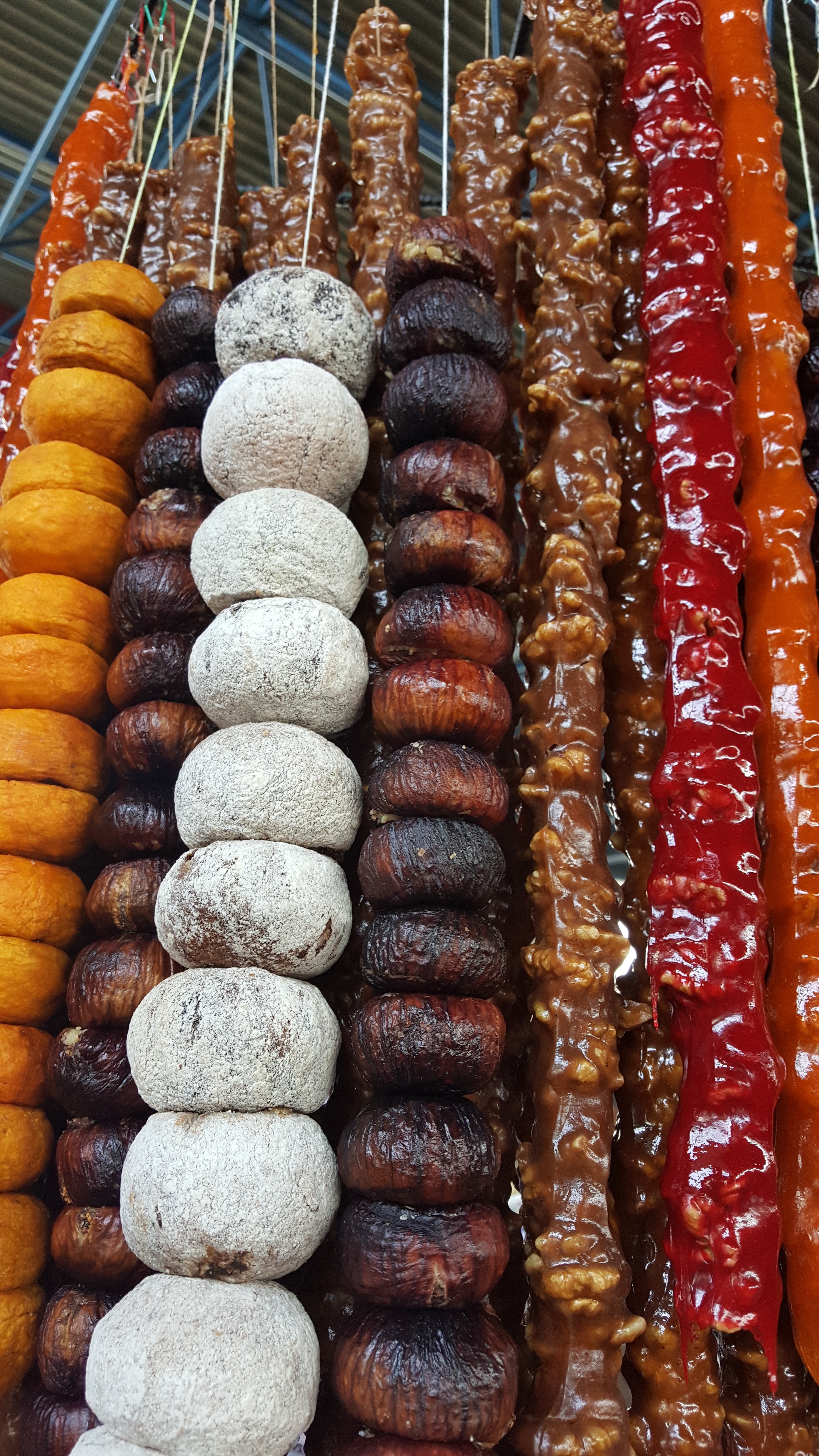
Strings of walnuts (and other nuts) covered in a layer of dried fruit roll

Dried fruits stuffed with nuts (left), more strings of nuts covered in fruit (right)
View of the slew of offerings; in the front are beautifully carved *candied* oranges stuffed with nuts and orange fruit filling

Lavash — traditional Armenian flat bread. It’s like a big oval Armenian tortilla.

Every kind of Armenian cheese you can imagine. The coolest is hanging just to the side of the woman on the right — it’s string cheese, but not like we know it, the cheese is actually string sized, roughly the size of strands of yarn!
Everything in this photo is pickled. Everything.

The produce was also incredible. We bought some apricots (one of the most famous Armenian fruits) and strawberries. All the fruits and vegetables in Armenian are terrific thanks to amazing volcanic soil and 300+ days of sunshine a year!
With full bellies, we were rejuvenated and prepared for the somber part of the day: our last stop was the Armenian Genocide Museum and Memorial. Both by coincidence and design, 2015 marks 100 years since the genocide occurred. We’ll leave it to you to read up on this as much or as little as you’d like, but in short, 1.5 million Armenians were killed by the Ottoman Turks, starting in 1915. Sadly, though this tragedy is often referred to as the event that lead to the coining of the term “genocide” only 24 countries formally recognize the genocide. Shamefully, this does not include the United States.

Approaching the memorial.


The monument (above left) is actually two parts that become one spire. The memorial (above right) is surrounded by stone pillars that surround the eternal flame and are leaning in towards it, as if they are mourning.

There were lots of very creative and interesting, billboards around the city. This was one of the simpler images, but was also one of the most common. The phrase “I remember and demand.” is core to the 100th anniversary, which remembers the 1.5 million Armenians that were killed during the genocide.
The Forget-Me-Not flower was chosen to be the symbol of remembering the genocide 100 years after it took place. This infographic does a great job of explaining the component symbols within the flower. (Click for a detailed view)
Certainly a tough end to the day, but an important one. Fortunately, there was just the pick-me-up we needed, right down the street: LAHMUJUN!

-G&J